Therapist for grieving: how to choose support that fits
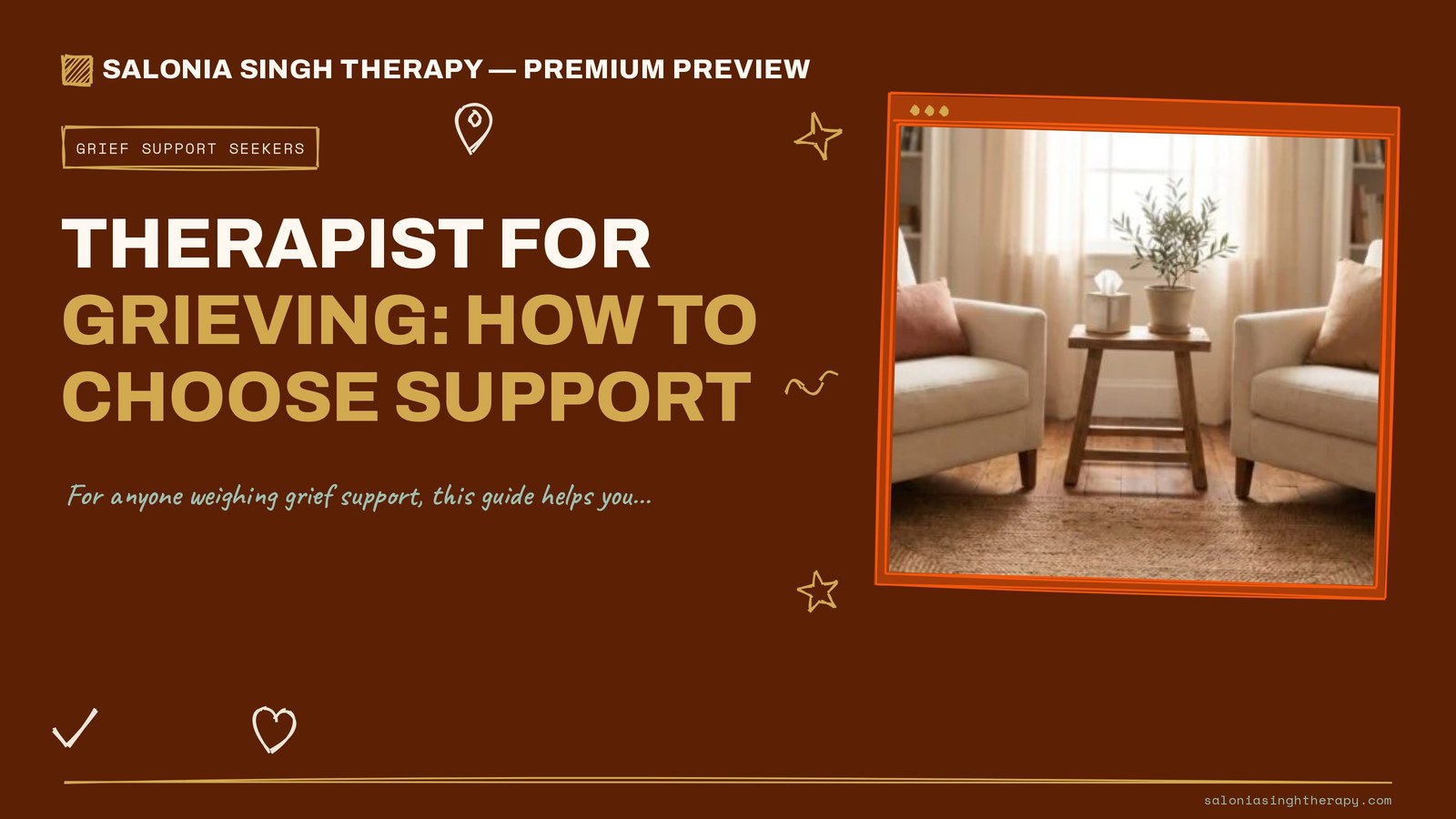
Choose a therapist for grieving by asking about experience with your kind of loss, how they would approach the concerns you describe, and whether the session format fits your privacy and access needs. Look for specific explanations rather than promises about recovery. You do not need to choose a therapy method in advance or disclose the full story before deciding whether to continue.
Expand key insights ▾
- Ask about experience with your kind of loss, not only a grief label.
- Request a plain-language explanation of how sessions might work.
- Compare focused attention, shared support, and practical access.
- Include cultural context and privacy needs in your decision.
- Treat a consultation as an opportunity to assess fit.
Table of Contents
- What type of therapist should you consider for grief?
- How do you assess a therapist's experience with loss?
- What should you ask about the therapy approach?
- Which support format matches what you need?
- How do culture, privacy, and access affect the choice?
- How would these questions change a real decision?
- What should you do with the consultation answers?
- Frequently Asked Questions
Looking for a therapist for grieving can mean wanting somewhere to talk about a death, a relationship that ended, or another loss that matters to you. The useful question is whether a provider can explain how their experience and way of working relate to your situation.
You may want privacy, help with a particular concern, or room to speak without being directed toward an outcome. Those preferences deserve a place in the decision. A consultation can help you compare options while keeping the details you are not ready to share private.

Two upholstered armchairs beside a small table and window Client photo (media library)
What type of therapist should you consider for grief?
Start with a mental health professional whose qualifications you can verify and whose experience includes the concerns you want to discuss. A professional title alone does not tell you how much work someone has done with bereavement or other losses.
Separate the basic qualification question from the grief-fit question. Ask what license or supervised role the provider holds, then ask how their experience relates to the kind of support you are seeking.
A description such as grief therapist or grief counselor is a starting point for questions, not enough information to make the choice. You want to understand what the person means by that description and what they actually do in sessions.
You can begin with a short statement: I am looking for support after a loss, and I would like to understand your experience before sharing more. That gives the provider enough context to respond without requiring a detailed account.
For the broader selection process, including qualifications and general fit, use our guide to choosing a therapist. Here, the focus is the extra information that matters when grief is the reason for seeking support.
How do you assess a therapist's experience with loss?
Ask about relevant experience in terms of your situation, rather than requesting a count of previous clients. Someone's ability to explain the scope and limits of their work is more useful than a broad assurance that they understand grief.
You might name the relationship or circumstances without describing the event: a parent's death, the end of a marriage, or a loss you find difficult to discuss. These are examples, not categories you must fit into.
- What experience do you have supporting people after this kind of loss?
- What grief-related training informs your work?
- How do you approach grief when the relationship included conflict or unresolved feelings?
- When would you recommend a different provider or additional support?
A useful response explains relevant work without revealing another client's private information. It should also leave room for your circumstances to differ from those of other people the therapist has supported.
Notice whether the provider distinguishes grief experience from adjacent work. Experience with life changes may be relevant, but you can still ask what specifically prepares them for the loss you describe.
If distressing memories or other concerns are part of what you want help with, name that during the conversation. Ask whether the therapist would address those concerns themselves, assess them further, or refer you elsewhere. You do not need to diagnose yourself to raise them.
What should you ask about the therapy approach?
Ask the therapist to describe what working together might involve in ordinary language. A method's name can be useful, but it does not explain what you would be invited to discuss, practice, or do between appointments.
For example, How would you work with me if I want to talk about guilt but am not ready to describe the loss in detail? gives the provider a concrete situation to respond to. Their explanation lets you assess the process without choosing a technique from a list.
Connect the method to your concern
If the therapist names an approach, ask why they would consider it for the concern you described. Follow with questions about what participation involves and what alternatives they would discuss if that approach did not suit you.
You might prefer open conversation, practical exercises, or a combination. Ask how those preferences would affect the work rather than assuming a therapy label determines every session.
An explanation should help you picture the experience. An assurance that a method is the best choice for everyone does not answer your individual question.
Discuss pace and goals separately
Pace concerns what you are ready to discuss now. Goals concern what you hope support will make possible. You can want help getting through a workday while remaining unwilling to tell the full story of the loss.
Ask how the therapist would respond if you wanted to pause a topic or disagreed with an exercise. Also ask how you would revisit goals if your needs changed.
A possible goal might be finding words for feelings you have kept private. Another might be discussing how to handle an upcoming family gathering. These are hypothetical starting points, not promises about what therapy will achieve.
Which support format matches what you need?
Compare formats by the kind of attention and participation you want. Individual therapy, a bereavement support group, and support from people you know have different purposes; one does not have to replace every other form of support.
Focused time with a therapist may match a preference for discussing private details. A group may match a wish to hear from others facing loss. Personal support may be what you want for companionship or practical help.
The trade-off is that focused professional attention does not provide the same peer exchange as a group. Conversely, shared discussion does not give every participant the whole meeting to explore their own concerns. Ask a specific provider or group facilitator how the format works before relying on it for a particular need.
| Option | Reason to consider it | Trade-off to weigh | Question to ask |
|---|---|---|---|
| Individual therapy | You want dedicated time to discuss your own concerns. | It does not provide a group of peers sharing their experiences. | How would you organize sessions around the concerns I describe? |
| Bereavement support group | You want conversation with others who have experienced loss. | Attention is shared, and participation rules vary. | Who facilitates the group, and can I listen before sharing? |
| Support from people you know | You want familiar company or help with daily responsibilities. | Loved ones may not be able to provide clinical support. | Would you be willing to help in this specific way? |
| Option | Reason to consider | Trade-off |
|---|---|---|
| Individual therapy | Dedicated time for your own concerns | No group of peers sharing experiences |
| Bereavement support group | Conversation with others facing loss | Shared attention; participation rules vary |
| Support from people you know | Familiar company or practical help | May not be able to offer clinical support |
How do culture, privacy, and access affect the choice?
These are separate fit questions. A therapist's experience may interest you, but the relationship still needs room for your values and a session arrangement you can actually use.
Describe the context you want respected
If family expectations, religious beliefs, or mourning practices matter to you, explain what you want the therapist to understand. Ask how they would respond if your wishes differed from those of relatives or your community.
Shared background may be a preference, but it does not answer every question about fit. Ask how the provider handles differences within a culture, including beliefs or customs they do not know.
You can be direct: I want space to discuss my grief without being advised to abandon practices that matter to me. Then listen for how the therapist would work with that request.
Separate professional confidentiality from physical privacy
Ask the therapist to explain confidentiality, its limits, and how records or communications are handled. Do not assume that confidentiality means there are no exceptions.
Physical privacy is a different issue. If online sessions are an option, consider whether someone could overhear you at home and discuss that constraint before scheduling.
For a group, ask about confidentiality expectations and how the facilitator addresses them. You need to understand the arrangement rather than assume it works like an individual appointment.
Check whether the arrangement is workable
Discuss appointment availability, online or in-person options, current fees, and cancellation terms before deciding. If location or travel affects your plans, ask whether the therapist can provide care where you will be during sessions.
A format you prefer may not be practical in your current circumstances. That is a reason to compare another arrangement, not a judgment about whether you are committed to getting support.
How would these questions change a real decision?
Consider this explicitly hypothetical situation: you want to discuss unresolved feelings after a parent's death, but your fixed constraint is that you cannot speak privately at home. You also do not want relatives to hear details of the relationship.
An online individual appointment might provide focused attention, yet it would not resolve the privacy constraint unless you could find a suitable private location. An in-person appointment could address that constraint if travel and scheduling were workable.
A bereavement group could provide shared conversation, but it might not match your wish to explore private relationship details at length. You would need to learn its participation rules before deciding whether it meets that need.
In this example, the first choice to investigate is a private individual appointment in a workable setting. That follows from the stated constraints, not from a claim that individual therapy is better for everyone.
If the reader's priority instead were hearing how others talk about loss, and shared discussion felt acceptable, a group would deserve more consideration. The purpose changes the choice.
This is why comparing only provider biographies can leave you stuck. A promising therapist still needs to fit the setting and kind of participation you can manage.

Illustration contrasting an open household doorway with a closed door and two empty chairs, with sound-wave motifs, a travel bag and a winding path.
What should you do with the consultation answers?
After the conversation, separate what you learned from what remains unclear. You are deciding whether there is enough relevant information to consider continuing, not whether a brief interaction proves the therapist will be right for every future concern.
Look for an understandable connection between your needs and the provider's experience, an explanation of how sessions could work, and a practical arrangement you can use. Also notice whether you could express a preference without being dismissed.
A therapist may need more information before discussing a treatment plan. That is different from avoiding basic questions about training, format, or fees. A request for further assessment should include an explanation of what still needs to be understood.
If a response leaves you uncertain, identify the unresolved issue before making another appointment. You can compare another provider, request clarification, or decide that the proposed format is not what you want.
To explore whether our available providers may be appropriate for your needs, contact our practice with a brief description of the support you are considering. Use the same grief-specific questions to assess fit rather than assuming that a general therapy practice provides the specialty you need.
Want to explore fit before making a decision?
Explore more from Salonia Singh Therapy — Premium Preview
How much does grief therapy cost?
Do I have to wait a certain amount of time after a loss?
How many sessions should I expect?
What if I cannot explain what I am feeling?
Can I seek support if my loss was not a death?
Can someone help me choose a therapist without joining my sessions?
What if I need immediate help while searching?
Choose based on the support you need now
Ready to talk?
Request a free consultation, call 818-570-2527 or email therapycontact@saloniasinghtherapy.com.