Couple therapist: how to choose for your relationship

Choose a couple therapist whose training fits your relationship concerns and whose way of working gives both partners room to participate. Before starting, ask how they structure difficult conversations, set goals, handle privacy, and respond when partners want different things. Compare those answers with your practical constraints and each partner's experience of being heard, rather than choosing on a profile or therapy label alone.
Expand key insights ▾
- Look for couples-specific training relevant to your main concern.
- Ask how the therapist handles interruptions and unequal participation.
- Both partners should have room to disagree and give feedback.
- Clarify privacy, goals, fees, and scheduling before committing.
- A consultation helps assess fit; it cannot guarantee an outcome.
Table of Contents
- What do you want help doing together?
- Which training and approach are relevant to your concern?
- How will the therapist structure difficult conversations?
- What expectations need to be clear before starting?
- How do you compare fit when your preferences differ?
- What should you evaluate in the early working relationship?
- Explore whether our practice fits the work you want to do
- Frequently Asked Questions
A couple therapist may sound like a good fit on paper while leaving an important question unanswered: what will happen when your usual disagreement enters the room? If one partner talks quickly and the other shuts down, a warm introduction alone does not tell you how the therapist will work with that difference.
Your decision needs more than a list of credentials. It needs a connection between your concerns, the therapist's relevant preparation, and a process you can both understand. Start with the work you want help doing, then use a consultation to explore how that work would happen.
What do you want help doing together?
Describe a recurring situation and the change you want, rather than deciding which partner needs fixing. For example, you might want to discuss household responsibilities without the conversation turning into an argument about whether either person cares.
That description gives a prospective therapist something concrete to respond to. It also lets you distinguish general experience with relationships from experience relevant to your concern, whether that involves trust, intimacy, parenting disagreements, or uncertainty about staying together.
You do not need a shared account of everything that has happened. Each partner can explain what feels difficult and what would make therapy worth attending, without agreeing on who started the problem.
Separate your goals from your preferred outcome
A goal might be to speak honestly about trust or understand why discussions repeatedly stall. A preferred outcome might be to remain together, rebuild closeness, or decide whether to separate.
If those outcomes differ, say so before starting. A useful question is, "How would you work with us if one person wants to repair the relationship and the other is unsure?" Listen for an explanation of scope, rather than a promise to persuade either partner.
Also identify what you are not seeking. If you want help making a relationship decision, sessions organized around communication exercises alone may not address your immediate question.
Name the context that changes the work
Include relevant family obligations, cultural expectations, identity concerns, or previous therapy experiences. Explain how they affect the present disagreement instead of assuming the therapist will infer them from your background.
For example, "We disagree about financial support for relatives" is more useful than asking only whether someone is culturally sensitive. You can then explore how the therapist makes room for different meanings of responsibility without treating either partner's values as the default.
Which training and approach are relevant to your concern?
Ask about preparation for working with couples specifically, not only the therapist's general experience. Michele Weiner-Davis's selection guidance emphasizes specific training and experience in marital therapy, a useful distinction when evaluating someone who also works with individuals.
Credentials and relevant experience answer different questions. Verify the professional credential through the appropriate licensing authority, then explore how the therapist's couples training connects to your particular concern.
You can ask, "What training informs your work with couples, and how would it apply to the pattern we described?" A response that explains the connection is more useful for selection than a long list of course names.
Translate method names into session activities
You may encounter labels such as the Gottman Method, emotionally focused work, or Imago therapy. Rather than choosing by name alone, ask what the approach means for your participation: practicing a conversation, exploring emotional responses, discussing earlier relationship experiences, or some combination.
Ask why the therapist would use that approach for your goals and how they would adjust if it did not feel useful. If they integrate several methods, explore what guides those choices.
The trade-off is that a method you find appealing may involve work you do not expect. A preference for practical tools, for example, does not automatically mean you want to avoid emotional exploration; clarify how the therapist connects those activities.
Discuss specialist needs without requesting private case details
If your central concern involves betrayal, sexual concerns, or another issue requiring focused experience, ask directly about relevant training and scope. You do not need stories about previous clients to understand the therapist's preparation.
A useful answer can explain the kinds of concerns they address, the limits of their work, and when they would recommend another professional. Recognizing a limitation is different from being unable to help with any relationship concern.

Illustration of shared research: a magnifying glass highlights abstract papers while a second hand holds a question-mark card beside an open notebook.
How will the therapist structure difficult conversations?
Bring a brief description of what happens during a disagreement. "I keep asking questions, my partner stops answering, and then I raise my voice" gives the therapist a clearer starting point than "We communicate badly."
Ask what they would do if that pattern appeared in a session. You are evaluating their explanation of the process, not asking them to resolve the disagreement during a consultation.
- How do you make space when one partner speaks much more than the other?
- What happens if we interrupt each other or keep returning to the same accusation?
- How do you respond when a partner needs a pause?
- How can either of us say that your understanding of the situation feels inaccurate?
Listen for how the therapist balances participation with direction. Equal room to speak is not necessarily identical speaking time, and feeling heard is not the same as having every interpretation endorsed.
Decide how much direction you want
Some readers want a therapist who interrupts an unproductive exchange and explains what to try differently. Others want more time to finish a thought before the therapist steps in.
Neither preference alone settles the choice. Ask how the therapist decides when to intervene and whether you can discuss the pace if it feels too fast or too passive.
For a quieter partner, an invitation to speak may be helpful, but being pressed to disclose before they are ready may feel different. Make that distinction part of the consultation instead of describing the preference only as wanting a "gentle" therapist.
What expectations need to be clear before starting?
Discuss the working agreement before sharing material whose handling matters to you. Expectations about goals, privacy, and attendance can change whether a therapist is a workable choice, even when the initial conversation feels comfortable.
Ask how goals will be established when partners disagree, what information is needed at the start, and how you will review whether the work remains relevant. Avoid treating a promised outcome as evidence of fit.
Understand privacy and separate communication
Ask whether the therapist meets with partners separately, how information from those meetings is handled, and what happens if a partner sends a private message between sessions. Do not assume your expectations match the therapist's policy.
Useful questions include, "What can remain private from my partner?" and "How do you explain confidentiality and its limits before we begin?" Request an explanation you understand, including who can access records and how messages should be sent.
If you fear retaliation for speaking honestly, seek confidential safety-focused support before deciding on joint sessions. Choosing a conversation style does not resolve a concern about whether disclosure itself is safe.
Make the practical commitment workable
Clarify the session fee, session length, recommended frequency, cancellation terms, and available appointment format. Ask whether the schedule you can sustain is compatible with the proposed work.
If insurance reimbursement matters, discuss billing with the practice and verify benefits with your insurer rather than assuming coverage from a directory listing. If partners will attend from different locations, establish whether that arrangement is permitted before relying on it.
Practical fit is a real selection factor, not a sign that you are insufficiently committed. An appealing therapist may still be the wrong choice if attending consistently would require arrangements you cannot maintain.
How do you compare fit when your preferences differ?
Separate fixed constraints from preferences. A fixed constraint might be a schedule you cannot change; a preference might be wanting more structured exercises or more open conversation.
Then compare what each therapist actually explained. The table below describes possible working styles to discuss, not ratings of particular providers or claims that every therapist fits one category.
| Possible style | What to explore | Potential fit | Trade-off to discuss |
|---|---|---|---|
| More structured | How turns, exercises, and interruptions are managed | Partners wanting help keeping discussions on track | Whether there is enough room for unfinished thoughts |
| More exploratory | How emotional meaning is explored and connected to goals | Partners wanting to understand reactions in greater depth | How the work maintains direction |
| Flexible combination | What guides changes in pace or activity | Partners with different participation preferences | Whether the rationale for each change is clear |
A hypothetical decision with a fixed constraint
Imagine that you and your partner can attend only during a shared evening window. You want direct help interrupting circular arguments, while your partner worries that frequent interruptions will make it harder to speak.
One hypothetical therapist has an appealing style but no appointment compatible with that window. Another can accommodate the schedule but describes mostly open conversation, without explaining how they would address repeated interruptions.
A further candidate can accommodate the window and explains a flexible structure: room for each partner's account, intervention when exchanges become repetitive, and opportunities to give feedback about pace. On those hypothetical facts, that candidate is the more workable starting choice because both the fixed constraint and the participation concern are addressed.
This does not prove the therapist will be effective. It explains why the choice follows from the information available, rather than from whichever partner had the stronger first impression.
| Possible style | Ask about | Potential fit | Trade-off |
|---|---|---|---|
| More structured | Turns, exercises, interruptions | Keeping discussions on track | Room for unfinished thoughts |
| More exploratory | Emotional meaning linked to goals | Understanding reactions in depth | Maintaining direction |
| Flexible combination | Reasons for pace or activity changes | Different participation preferences | Clear rationale for each change |
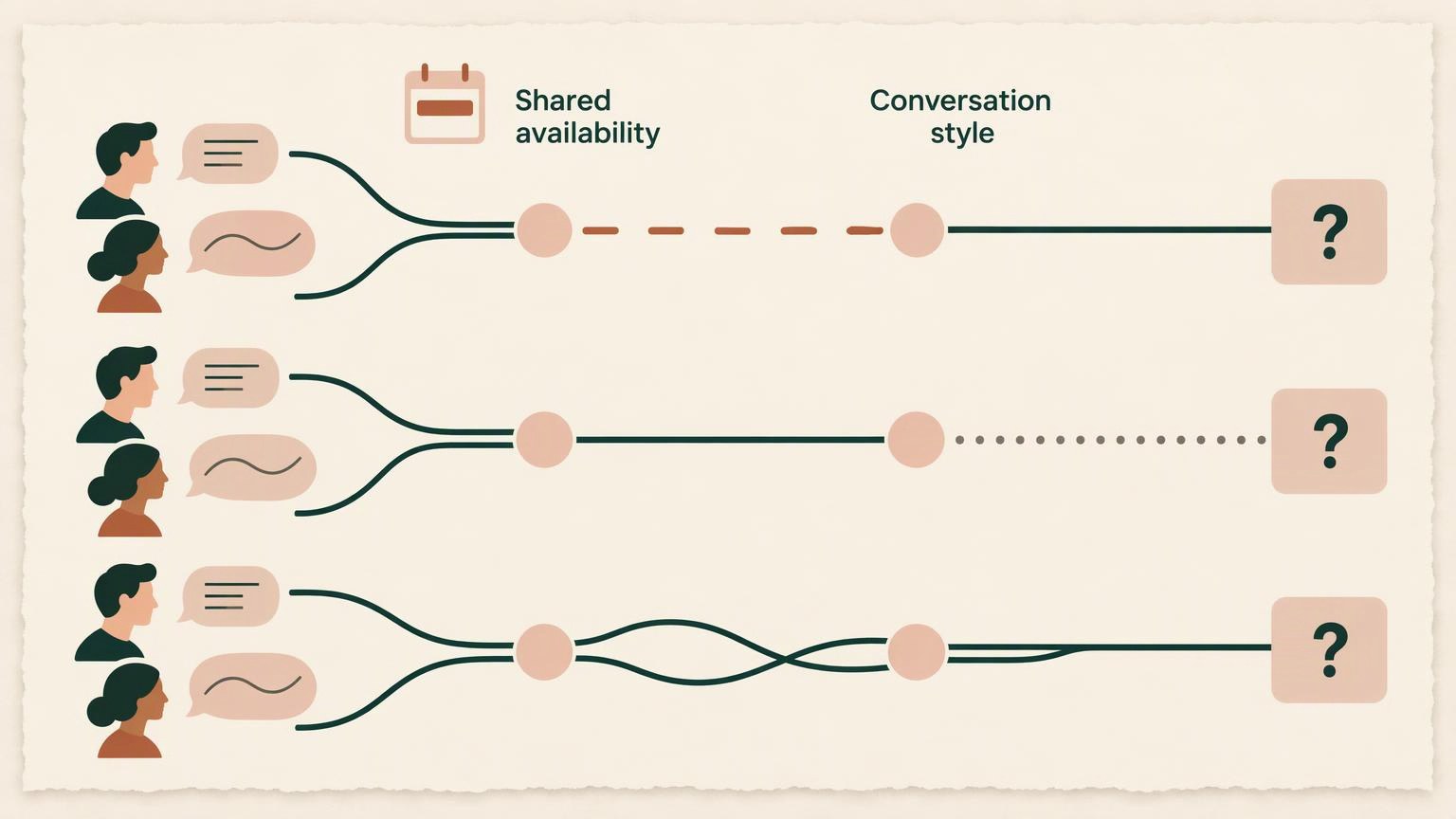
Illustration of three comparison paths, with paired profiles, a calendar icon, availability and conversation-style labels, and open question cards.
What should you evaluate in the early working relationship?
Compare the process you discussed with what happens after you begin. Can both partners explain the purpose of the work, bring up a concern about the session, and recognize how the therapist is connecting conversations to your goals?
Discomfort alone does not settle whether the fit is wrong. Distinguish discomfort about a difficult topic from a recurring experience of being dismissed, misrepresented, or unable to question the process.
If something feels off, describe an observable moment: "When the conversation moved on, I had not finished explaining my concern." That gives the therapist an opportunity to respond to a specific experience.
Notice whether the response clarifies the misunderstanding, changes the process where appropriate, or explains the reasoning respectfully. You do not have to stay solely because you have already invested time in beginning.
Use goals that you can discuss, not guaranteed deadlines
Examples might include being able to finish a difficult conversation, express disagreement without personal attacks, or speak honestly about uncertainty. These are possible goals to develop with a therapist, not promised treatment results.
Ask how you will review them and what would prompt a change in approach. A review should make room for each partner's account, including the possibility that one person finds the work useful while the other does not.
Explore whether our practice fits the work you want to do
You can review our couples therapy page as a starting point for considering relationship-focused support. Use your main concern and participation preferences to guide the next conversation, rather than assuming a service description answers every fit question.
When you are ready, contact us about fit and current availability. Explain the relationship concern you want help addressing and the practical constraint that would affect attendance.
Bring the questions that matter to both of you.
Explore more from Salonia Singh Therapy — Premium Preview
How much does couples therapy cost?
Should a therapist's age or gender determine our choice?
Can we consult more than one therapist?
What if my partner does not want to attend?
How long should we expect therapy to take?
Can we use a therapist one of us already sees individually?
Choose a process you can both understand
Ready to talk?
Request a free consultation, call 818-570-2527 or email therapycontact@saloniasinghtherapy.com.